What is Bioengineering?
Bioengineering is the central mechanic of Honeycomb: The World Beyond. Rather than just surviving, Hennessy's mission for EON Corp is to document, study, and manipulate Sota7's alien lifeforms. Crossbreeding two parent specimens in your Laboratory produces a hybrid organism that inherits a mix of both parents' traits.
These hybrids can have dramatically useful properties: higher caloric yield, toxic defense chemicals, bioluminescence for night navigation, growth-accelerating root systems, and more. The right crossbreeding chain can completely change how you interact with the environment.
Scan species → collect specimens → build Lab → crossbreed → analyze hybrid traits → scan hybrid → crossbreed again → unlock planet secrets.
The Two Crossbreeding Methods
Method 1: Grafting
Grafting is a physical combination technique. You take a specimen (or harvested part) from Species A and physically bond it to a living or cultured specimen of Species B inside the lab bench. The graft forms a new organism that grows the bonded structure — inheriting functional traits from both parents.
Grafting works best when combining structural traits: root depth, stem tensility, bark hardness, photosynthetic surface area. Think of it as a physical, visible change to the plant body.
Method 2: Allogamy
Allogamy is cross-pollination — you introduce the pollen or gametes of one species into the reproductive structures of another, allowing natural genetic mixing. The result is a new seedling with blended DNA rather than a structurally grafted organism.
Allogamy is better for chemical trait transfer: toxin profiles, nutritional density, bioluminescence, and adaptive chemical defenses. The hybrid looks less obviously "merged" but has deeply changed internal chemistry.
| Method | Best For | Required Lab Equipment | Output Type |
|---|---|---|---|
| Grafting | Structural, physical traits | Lab Bench + Grafting Clamp | Chimeric plant body |
| Allogamy | Chemical, metabolic traits | Lab Bench + Pollination Chamber | New seedling / egg |
Visual: How Grafting Works
This diagram illustrates the conceptual process of combining two Sota7 species via Grafting:
+Water absorption
+Caloric density
+ High yield
+ NEW: Drought resistant
🔬 Sota7 Crossbreeding & Grafting Simulator
LAB BENCH V1.0Select two base flora/fauna specimens and your synthesis methodology to predict the resulting hybrid's emergent traits and utility score before expending lab reagents.
✨ Amber Crystal Chimeric Specimen
COMPATIBLE (98%)Note the emergent trait (Drought resistant) — hybrid combinations sometimes produce traits that neither parent had individually. Discovering these emergent properties is a key part of the game's research loop.
Building and Using the Laboratory
What You Need
Before your first crossbreeding experiment, you must build the Laboratory module. The lab appears in the building menu once you have:
- Scanned at least 4 distinct species and logged them in your Field Journal
- Collected structural materials (stone chip, metal fragment, fiber weave) for construction
- Placed a Shelter module (the Lab requires an adjacent built structure)
The Lab Interior
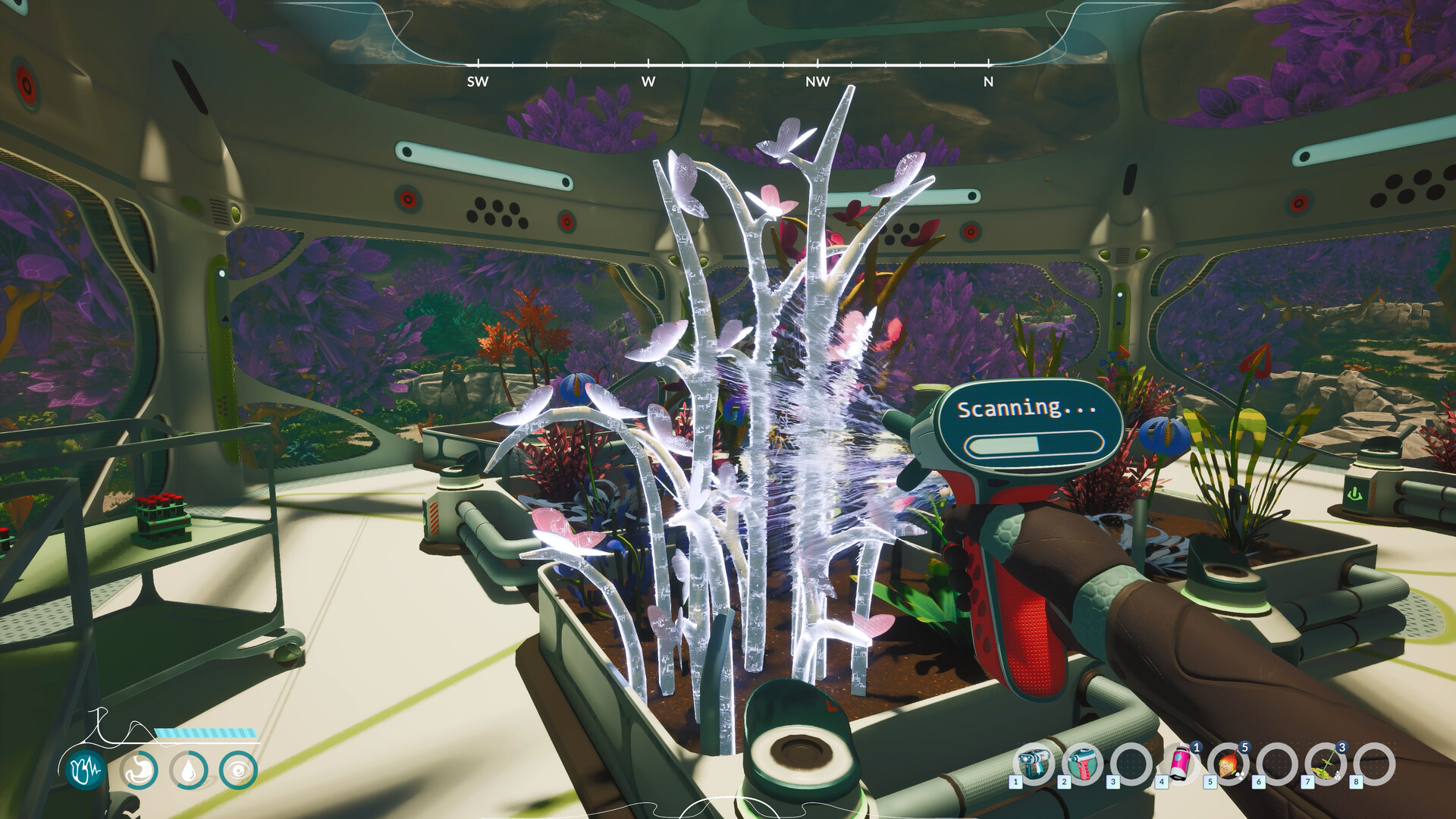
Once built, the lab interior (screenshot_6) shows your workspace: a central planting/grafting bed, wall-mounted specimen racks, a scanner station, and viewport windows showing the alien landscape outside. All crossbreeding happens at the central lab bench.
Running Your First Experiment
- Enter the Lab and approach the central bench
- Open the Crossbreeding Menu — shows available specimens and their compatibility indicators
- Select two compatible species (green indicator = compatible; red = incompatible)
- Choose Method: Grafting or Allogamy
- Confirm — the experiment begins. A scanning animation plays (identical to the field scanner)
- After the timer: open the Field Journal to see the new hybrid's trait profile
Not all species combinations are compatible. Attempting an incompatible graft wastes specimens. Always check the compatibility indicator before confirming. The Field Journal's cross-reference page shows known compatible pairs as you discover them.
Reading the Hybrid Trait Profile
After a successful experiment, the new hybrid's trait profile appears in your journal. Each trait has a strength value, an expression rate (how reliably the trait appears in offspring), and a utility tag (Food / Defense / Research / Construction). Traits with high expression rates are candidates for further crossbreeding to reinforce specific lines.
Advanced: Multi-Generation Breeding
Once you have a first-generation hybrid, you can use it as a parent in a second crossbreeding experiment. This is how you build specialized trait stacks:
Example Breeding Chain (Confirmed — Pre-launch developer info)
- Gen 1: Orange River Plant × Amber Plains Shrub → Dual-Nutrient Hybrid (Food trait)
- Gen 2: Dual-Nutrient Hybrid × Crystal Cavern Bloom → Tri-Nutrient Crystal Hybrid (Food + bioluminescence)
- Gen 3: Tri-Nutrient Crystal Hybrid × Toxic Underbrush → Fortified Hybrid (Food + bioluminescence + chemical defense)
By Gen 3 you have a plant that feeds you, lights your base at night, and deters small fauna — all from three sequential crossbreeding runs.
Specific species names and exact trait combinations will be verified and updated once the full game launches September 8, 2026. The mechanism descriptions above are confirmed from official developer materials. Check back after launch for the full crossbreeding database.